



Direct Superior Hip Replacement
Direct Superior Hip Replacement
Most people who come to see me about a hip have already heard the rules. Do not bend past 90 degrees. Do not cross your legs. Do not sleep on your side. Sit only on a raised toilet seat.
I use an approach that makes those rules unnecessary. My primary hip replacement patients go home with no hip precautions.
— Adam J. Cien, DO
What the Direct Superior approach is
Your hip is a ball and socket. What holds the ball in the socket is not the bone — it is a sleeve of muscle and tendon wrapped around the joint.
Older hip replacement techniques cut through part of that sleeve to reach the joint. It heals, but while it is healing the hip is less stable than it will be later. That is where hip precautions come from. They are rules to protect a hip while the muscle sleeve knits back together.
The Direct Superior approach reaches the joint from above and works between the muscles instead of cutting through them. The thick band of tissue along the outside of your thigh stays intact. The small rotator muscles at the back of the hip stay intact. The muscles that keep your hip stable are still doing their job the day after surgery.
That is the whole idea. Everything else on this page follows from it.
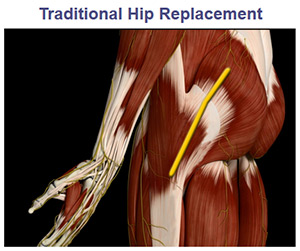
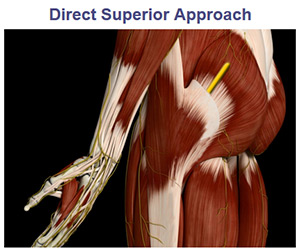
No hip precautions after primary Direct Superior hip replacement
From the day of surgery you can sit in a normal chair, sleep on your side, cross your legs, bend over to tie your shoe, and use a standard toilet. You do not need an abductor pillow. You do not need a raised toilet seat. You do not need a reacher or a sock aid.
There is one thing I do ask. No resisted hip rotation for the first four to six weeks. In plain terms: do not twist the hip against weight, against a resistance band, or against someone's hand. Turning the leg on its own is fine - it is the resistance I want you to avoid.
That gives the tissue I worked between time to seal back together at full strength. Your therapist will know exactly what this means and will work around it.
Everything else is open.
What that changes about your recovery
Sleep. You sleep in your own bed, in whatever position you find comfortable. Patients underestimate how much this matters until they have spent two weeks pinned on their back.
Equipment. There is a shorter list of things to buy or rent before surgery.
Therapy. Your therapist spends the visit on walking and strength instead of on rules.
Worry. Most of the fear around hip replacement is fear of doing something wrong and undoing the surgery. That fear largely goes away.
What it does not change: this is still a real operation, and recovery still takes months. You will still be tired. You will still have swelling. You will still have days in week three that feel worse than day ten. No hip precautions is not the same as no recovery - it means your recovery is not spent managing restrictions.
Am I a candidate?
Most people are. I use the Direct Superior approach for the large majority of my primary hip replacements.
A small number of patients are better served by a different approach - usually because of prior hip surgery, unusual anatomy, or hardware that has to come out at the same time. If that is your situation I will tell you at your visit, explain why, and walk you through what changes.
If you are having a revision hip
A revision is when we redo a hip replacement that was done before. For most revisions I use a posterior approach, and traditional hip precautions do apply: no bending the hip past 90 degrees, no crossing the operated leg past the midline of your body, and no turning the foot inward, for the first six weeks. An abductor pillow at night.
If this is you, your discharge paperwork will say so and your therapist will reinforce it at every visit.
If you are not sure which approach you had, call my office and we will tell you.
What recovery looks like
I have written all of this out for my patients - week by week, what your body is doing, what your job is, and when to call. It is on this site and it is free to read whether or not you are my patient.
Robotic assistance
The Direct Superior approach can be combined with Mako robotic assistance. Mako uses a CT scan of your own hip to build a three-dimensional model before surgery, so implant position is planned against your anatomy rather than estimated in the operating room.
Whether robotic assistance adds anything for your particular hip is something we decide together. It is a tool I use where it helps, not something I apply to every case by default. If you want to know more about how I use it, the robotic joint replacement page goes into detail.
Common questions
Will I have hip precautions after surgery?
Not after a primary Direct Superior hip replacement. You can sit, sleep, bend, and cross your legs normally from day one. The single restriction is no resisted hip rotation - twisting the hip against resistance - for the first four to six weeks. Revision hips done through the back are different, and those precautions do apply.
Is Direct Superior the same as anterior hip replacement?
No. Both are muscle-sparing, but they reach the hip from different directions. Direct Superior comes in from above and behind. Anterior comes in from the front. Both avoid cutting the muscles that stabilize the hip, which is why neither one typically requires hip precautions. Direct Superior does not require a special operating table and can be extended during surgery if something unexpected comes up, which is why I prefer it.
How big is the incision?
Usually 8 to 12 centimeters - about three to four and a half inches. It sits along the upper outside of the hip. If your anatomy calls for more exposure I will take it. I would rather do the operation well than finish with a shorter scar.
Can I sleep on my side?
Yes, from the first night, on whichever side is comfortable. A pillow between the knees if it helps. No abductor pillow needed.
Will I stay in the hospital overnight?
Most of my primary hip replacement patients go home the same day. Some stay a single night. Which one applies to you depends on your health, how you do in the recovery room, and where the surgery is done. We plan this out ahead of time so you are not guessing on the day of surgery.
How long will I use a walker?
Plan on about six weeks. That is the protocol, not a sign of a slow recovery. If you and your therapist agree you are steady enough to step down sooner, that is fine with me.
When can I drive?
Not while you are taking narcotic pain medication, and not until you can move the leg quickly and confidently. For most patients that is somewhere in the second or third week. Line up rides for the first two to three weeks.
Do you use this approach for everyone?
For the large majority of primary hip replacements, yes. Prior surgery, unusual anatomy, or a revision may call for something different. I will tell you at your visit if that applies to you.
Come talk to me about your hip
If your hip has been limiting what you do and you want to know whether a replacement makes sense, come in. Bring your questions. I see patients in South Bend, Mishawaka, Elkhart, Plymouth, and Michigan City.