



Quad-Sparing (Subvastus) Knee Replacement
A total knee replacement can be done through more than one route to the joint. The route your surgeon chooses does not change the implant, but it does change the first several weeks of your recovery.
Dr. Cien performs the subvastus approach, also called the quad-sparing or muscle-sparing approach. It reaches the knee underneath the quadriceps muscle rather than cutting through the quadriceps tendon to get there.
What the subvastus approach is
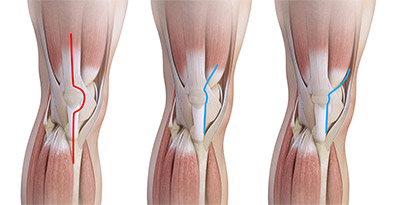
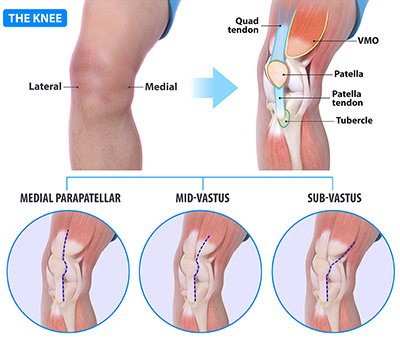
The quadriceps is the large muscle group on the front of your thigh. Its tendon runs over the top of the kneecap and it is what straightens your leg, gets you out of a chair, and carries you up stairs.
The traditional approach to knee replacement, called the medial parapatellar approach, splits that tendon to open the joint. It gives excellent exposure and it has been the standard for decades. The tendon is repaired at the end of the operation and it heals, but the repair is part of what your early recovery is spent on.
The subvastus approach goes underneath the muscle instead. The vastus medialis is lifted off the septum beside it and moved aside, the joint is opened below it, and the muscle settles back over the repair at the end. The extensor mechanism is left intact.
This is not a new idea. The approach first appeared in the German surgical literature in 1929 and was described for modern total knee replacement by Hofmann and colleagues in 1991. It has been compared with the traditional approach in randomized trials ever since.
What it changes about your recovery
Randomized trials and pooled analyses comparing the subvastus approach with the traditional approach have generally reported less pain in the early weeks, less pain medicine used, and better early range of motion. Quadriceps control tends to return sooner, which is why straight leg raises usually come back earlier.
What does not change is the long term result. At one year and beyond, the two approaches perform the same. The durability of a knee replacement comes from where the implant sits and how the knee is balanced, not from the route used to reach it.
So the honest way to describe the benefit is this. The approach buys you an easier first six weeks. It does not buy you a better knee at five years. Both of those statements matter.
Robotic assistance is available with this approach
Dr. Cien uses Mako robotic-arm assisted technology for knee replacement, and it can be used together with the subvastus approach.
The two do different jobs. The approach is how the joint is reached. The robot helps plan and execute where the implant sits and how the knee is balanced. Using both means a muscle-sparing route in and a plan built around your own anatomy.
Robotic assistance is an option, not an automatic part of every case. Dr. Cien will tell you whether he is recommending it for your knee and why.
Not every knee is a candidate
The subvastus approach is more demanding to perform and it is not the right choice for every patient. Thigh muscle bulk, body habitus, previous knee surgery, and a knee that is already stiff all affect whether the joint can be exposed safely through it.
Exposure is not a detail. A surgeon who cannot see the knee properly cannot position the implant properly, and implant position is what determines how long the knee lasts. When the subvastus approach is not the right call, Dr. Cien will say so and explain what he is recommending instead.
That decision is made after he examines your knee and reviews your x-rays, not before.
Talk it through
If you are considering knee replacement and you want to know whether a quad-sparing approach is an option for your knee, book a consultation. Bring your questions. This page is a starting point, not a substitute for having your knee examined.
Common questions about quad-sparing knee replacement
What is a quad-sparing knee replacement?
Will my quadriceps muscle be cut?
No. The quadriceps tendon is not divided. The muscle is lifted and held aside while the joint is exposed underneath it, then it settles back into place at the end of the operation.
Is this the same as minimally invasive knee replacement?
They overlap but they are not the same thing. Minimally invasive usually refers to a smaller skin incision. Quad-sparing refers to what happens underneath the skin. Dr. Cien focuses on the second, because what is done to the muscle matters more to your recovery than the length of the scar.
Is the incision smaller?
Usually not by much. Incision length is similar to a standard knee replacement. Good exposure is what allows the implant to be positioned accurately, and that is worth more than a shorter scar.
How is this different from a traditional knee replacement?
A traditional knee replacement splits the quadriceps tendon above the kneecap to open the joint. The subvastus approach leaves that tendon intact. Most patients notice the difference in the first several weeks rather than later on.
Does it hurt less?
In the early weeks, generally yes. Randomized trials comparing the two approaches have reported less pain, less pain medicine used, and better early range of motion with the subvastus approach. By a year out, the two are the same.
Is the implant different?
No. The same implants are used. How long a knee replacement lasts depends on implant position, balance, and your own anatomy, not on the approach.
Can it be combined with the Mako robot?
Yes. Dr. Cien uses Mako robotic-arm assisted technology and it works alongside the subvastus approach. The robot helps with planning and implant position. The approach is how the joint is reached.
Will I go home the same day?
Most patients go home the same day. Some stay one night. That is decided by how you are doing after surgery, not by a fixed rule.
When does physical therapy start?
Outpatient therapy starts between day 5 and day 10 after surgery. The wait is deliberate. Starting before the early swelling settles tends to leave patients sore and stiff without getting them further ahead at six weeks.
When can I drive?
For most patients somewhere between two and six weeks. Two things have to be true first. You must be completely off narcotic pain medicine, and you need the strength and reaction time to move from gas to brake in an emergency stop. A left knee usually lets you drive sooner than a right one.
When can I go back to work?
If you can wait until six weeks, wait. Patients who go back earlier often lose range of motion they worked hard to gain. Desk work is more demanding than it sounds. A job on your feet, or one with stairs and lifting, usually needs eight to twelve weeks.
Am I a candidate?
Not every knee is. Thigh muscle bulk, body habitus, previous knee surgery, and existing stiffness all factor in. Dr. Cien makes that call after examining your knee and reviewing your x-rays, and he will tell you either way.
Where does Dr. Cien see patients?
South Bend, Mishawaka, Plymouth, and Elkhart. Call 574-247-5164 or request an appointment online.