



Metal Allergy and Joint Replacement
Worried About a Metal Allergy Before Your Hip or Knee Replacement?
You have options. Here’s what a metal allergy actually means for joint replacement, how we test for it, and the implants we use to avoid it.
What is a metal allergy?
A metal allergy is your immune system reacting to metals it comes into contact with. If you’ve ever had a rash from a watch, earrings, a belt buckle, or the back of a phone, you may already know what it feels like. The most common metal people react to is nickel, but some people also react to cobalt, chromium, or other metals.
Why does this matter for joint replacement?
Most modern hip and knee implants are made from a metal alloy called cobalt-chromium, which contains small amounts of nickel. Once the implant is in your body, very tiny metal particles can be released over time as the joint moves. In most patients, this causes no problem at all. But in a small group of patients with a true metal allergy, those particles can trigger an immune reaction that may lead to:
- Persistent pain in the joint
- Swelling or stiffness that doesn’t improve
- A skin rash or discoloration over the joint
- Slower-than-expected recovery
The good news: a true allergic reaction to a joint implant is uncommon. Most pain after a joint replacement has another cause. But if you have a known metal allergy - or a strong suspicion of one - it’s something we should plan for before surgery, not after.
How common is metal allergy?
About 10–15% of the general population has some degree of nickel sensitivity, and it’s more common in women than men. The actual rate of a problem caused by an implant is much lower - most studies estimate that fewer than 5% of joint replacements have any issue thought to be related to metal sensitivity. But because hundreds of thousands of joints are replaced in the U.S. each year, even a small percentage adds up to real patients.
That’s why we take this seriously. Signs you might have a metal allergy
Tell us before surgery if you’ve ever had:
- A rash or itching from costume jewelry, watches, or belt buckles
- Skin reactions to snaps, zippers, or eyeglass frames
- A reaction to dental work or a previous surgical implant
- A diagnosed nickel, cobalt, or chromium allergy
If you’ve already had a joint replacement and you’re dealing with unexplained pain, swelling, a rash over the joint, or stiffness that nobody can explain - and infection and mechanical problems have been ruled out - a metal sensitivity work-up may be the next step.
How we test for metal allergy
Lymphocyte Transformation Test (LTT) - a blood test. A blood sample is sent to a specialty lab, where your immune cells are exposed to common implant metals (nickel, cobalt, chromium, titanium, molybdenum, vanadium, aluminum, iron, zirconium) and bone cement components. The lab measures how strongly your immune system reacts to each one.
For patients who come to me for a second opinion on a metal allergy, I use Orthopedic Analysis (also known as OrthoAnalysis), a specialty lab in Chicago that focuses specifically on testing immune reactions to implant materials. Their test is widely used by joint replacement surgeons across the country and tests against the exact metals used in modern hip and knee implants.
It’s worth being honest about one thing: even the best metal allergy tests aren’t perfect. A positive test does not always mean you’ll have a problem with an implant, and a negative test doesn’t completely rule it out. That’s why we look at the test results, your history, and your symptoms together - not any one piece in isolation.
What we do if you have a metal allergy: the Stryker Triathlon Gold
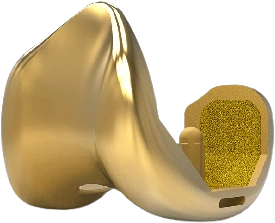 Image courtesy: www.stryker.com
For patients with a confirmed or strongly suspected metal allergy who need a knee replacement, I use the Stryker Triathlon Tritanium Gold implant.
Here’s why, in plain language:
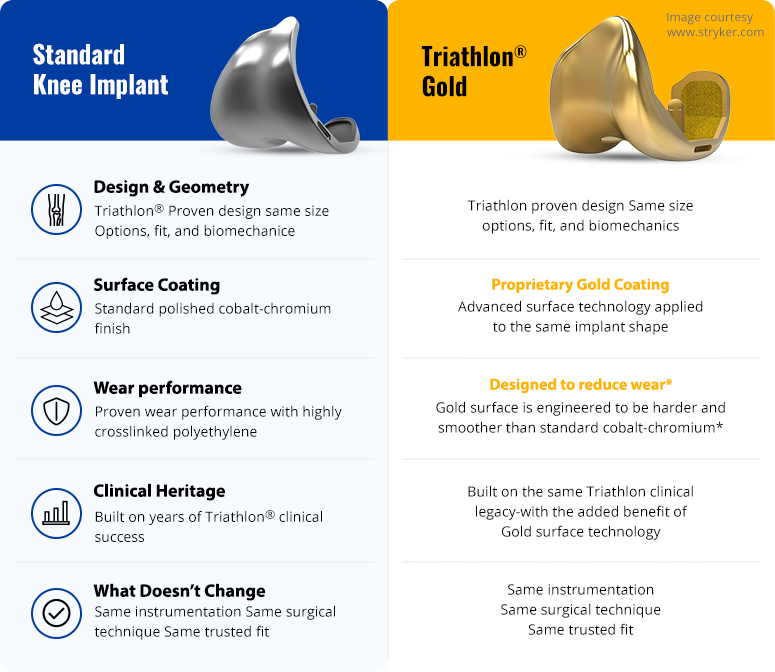
- The “gold” comes from a titanium nitride coating on the femoral component (the part that caps the end of your thigh bone). Titanium nitride has a gold color and creates a hard, smooth barrier between you and the underlying metal.
- It’s built on the Triathlon platform, which is one of the most studied and longest-tracked knee replacements in the world, with over 20 years of clinical history showing strong durability and patient satisfaction.
- It’s designed as an alternative to cobalt-chromium for patients with metal sensitivity concerns, while keeping the same shape, fit, and surgical workflow as the standard Triathlon - so you don’t trade reliability for a “specialty” implant.
- It works with both press-fit (cementless) and cemented techniques. This matters because some patients are also sensitive to bone cement, and a cementless option avoids that exposure entirely.
- It’s compatible with Mako robotic-assisted surgery, which is what I use for the great majority of my joint replacements. The robot allows for highly precise bone cuts and alignment based on a 3D plan built from your CT scan, which has been shown to reduce soft-tissue trauma and improve implant positioning.
In short: you get the implant designed for metal-sensitive patients, placed using the most precise technology available, by a surgeon who does this every day.
What about hips?
For patients with a metal allergy who need a hip replacement, we use implants and bearing surfaces that minimize metal exposure - typically a ceramic head on a polyethylene liner, with a titanium stem and cup. Titanium is well tolerated even in most metal-sensitive patients, and the ceramic-on-plastic bearing avoids the metal-on-metal wear that historically caused the most allergy concerns.
We’ll go through the specifics with you in clinic based on your test results, anatomy, and activity level.
What to do next
If you’re concerned about a metal allergy and you’re considering a hip or knee replacement - or you’ve already had one and something doesn’t feel right - bring it up at your visit. We’ll go through your history, decide whether testing makes sense, and build a plan from there.
FAQ section
Q: Do I need metal allergy testing before every joint replacement?
No. Routine testing for every patient isn’t recommended by the major orthopedic societies, and most patients do not need it. Testing is most useful when you have a personal or family history of metal allergy, a history of skin reactions to jewelry or buckles, or unexplained problems after a previous implant.
Q: Is the Triathlon Gold a “gold” implant?
No, it’s not made of solid gold. The gold color comes from a titanium nitride coating on the surface of a titanium implant. The coating creates a hard, smooth, biocompatible barrier and is what allows the implant to be used in patients with metal sensitivity concerns.
Q: I had a rash from cheap jewelry years ago. Does that mean I’ll react to my joint replacement?
Probably not. Skin reactions on the outside of the body don’t always predict how your body will respond to an implant deep in the tissue. But it is worth telling your surgeon. We’ll decide together whether testing makes sense for you.
Q: What if I test positive for a metal allergy?
We pick an implant designed to avoid that metal - most often the Triathlon Gold for knees, and a ceramic-on-polyethylene construct with a titanium stem for hips. You still get a high-quality, modern joint replacement.
Q: Does insurance cover metal allergy testing?
Coverage varies. Many plans cover testing when there’s a documented history of metal allergy or unexplained problems after a prior implant. Our team can help you understand what your specific plan covers before you commit to testing.
Q: I already have a knee or hip replacement and I think I might be reacting to it. What should I do?
Make an appointment. We’ll work through the most common causes of pain after joint replacement first - infection, loosening, alignment, soft-tissue issues - because those are far more common than a true metal reaction. If those are ruled out and an allergy is still suspected, we’ll send testing through OrthoAnalysis and discuss options from there.